Lavalier
 Headset & Earset
 Handheld
 Instrument
 Pencil
 Shotgun
 Gooseneck
 Immersive
 Kits
Kits
Fast facts about the piano
A bit of history and key facts about the acoustic and physical features of the piano.

The name
The piano was invented around 1700 by Italian Bartolomeo Cristofori, who introduced hammers to the harpsichord. He called the first version the “clavicembalo col piano e forte,” which was later reduced to "pianoforte" ("soft-loud") because it was the first keyboard instrument that could play both soft and loud notes. Today, the name is just 'piano' (or 'grand piano').
The keyboard
The keyboard usually has 88 keys, ranging from the lowest note A0 (27.5 Hz) to the highest C8 (4186.01 Hz).
The white keys are approximately 23.5 mm (0.92 in) wide, and the black keys are approximately 14 mm (0.54 in) wide. The keyboard’s total width (88 keys) is approximately 122-123 cm (48 in). The keyboard’s standard height above the floor is 75 cm (29.5 in).
The strings
The piano contains approximately 230-236 steel strings, organized into two groups, which partly cross each other in the cabinet (space optimization). One section usually encompasses A0 to Bb2, and the other section B2 to C8.
The strings vary in length, thickness and tension. The highest notes are generated by three strings (B2 to C8). The mid/low notes are generated by two copper-wound strings (B1 to A2), and the lowest notes are generated by one copper-wound string (A0 to E1-B1, depending on instrument).
In a good piano, the transitions between groups are not noticeable. However, for close miking, the microphone position must be carefully monitored to ensure a perceived smooth transition between string groups.
The length of the instrument depends on the length of the strings. They vary from the baby grand’s 1.5 m (5 feet) to the concert grand’s 2.75 m (9 feet). (Upright pianos are not mentioned here.)
Total string tension is up to approximately 35,000 pounds.
The hammers
The hammers' blows against the strings produce the tones. The characteristics of the piano sound depend on the hammers’ action: changes in tone quality with dynamics (from pp to ff) and tone quality across the keyboard from A0 to C8.
A soft blow creates low SPL and few higher harmonics. A heavy blow produces louder tones with more harmonics, resulting in a richer spectrum. Low notes may contain many harmonics (≥ 50), and the highest notes produce only a few harmonics (≤2).
The pedals / dampers
Modern pianos usually have three pedals:
The left pedal: soft pedal (or “una corda”). When pressed, hammers only hit two strings of three-stringed tones (originally, only one string) by moving the hammers’ entire action to the side. Lower tones may be reduced in level/spectrum by being hit by a separate part of the hammer.
The middle pedal: usually the sostenuto pedal. When pressed during play, only the tones of keys held down at the time of blow are sustained. The following tones are damped. (Some pianos don’t have a middle pedal, or have a middle pedal with a different purpose, like a muting function).
The right pedal: the sustaining pedal (or damper pedal). When pressed, the strings vibrate freely.
There is no damper on the highest strings, (typically F#6-C8).
The lid
The lid’s main function is to control the sound radiated from the piano. When closed, the SPL and the spectrum are limited. However, when raised, the lid’s angle determines the sound distribution into the surroundings. In a concert setup, the angle may vary depending on whether the piano is floor-standing or lifted on the stage.
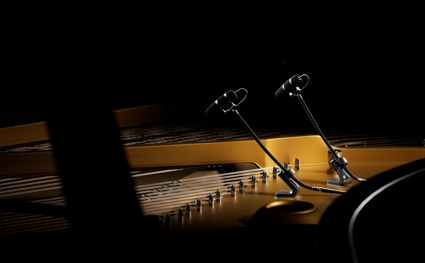
For PA/SR it is common to put microphones inside the piano with a closed lid. The sound isolation from outside sources is then in the range of 10 dB, often with no attenuation at low frequencies due to resonances inside the cabinet.
For some studio purposes, the lid may even come off completely.
The stick(s)
The sticks are there to accommodate the chosen lid angle. Commonly, two or three sticks are supplied with the piano: one or two shorter sticks and one long. Usually, there are cups mounted inside the lid for each stick used. The angle between the stick and lid should always be 90° (for safety reasons).
Some engineers bring their own sticks for the pianos, they are going to record, just to optimize the sound field from the instrument.