 Lavalier
 Headset & Earset
 Handheld
 Instrument
 Pencil
 Shotgun
 Gooseneck
 Immersive
 Kits
Kits
 Receiver
 Bodypack Transmitter
 Handheld Transmitter
 Antennas
 Antenna Distribution
 Wisycom
Two worlds, one show
The tour unfolds in two distinct halves. The first is a solo piano set, quiet and textural. The second shifts into modular synthesis and electronics. Harley's job was to make both halves feel like a single, seamless experience — which meant the piano half had to hold its own against what was coming after it, without losing any of its delicacy in the process.
Every piano is different
Consistency is one of the greatest challenges in live touring. Each venue brings a different instrument, a different acoustic environment and a different system configuration. "Every piano is different," Harley says. "Some are brighter, others are warmer and still others are more aggressive. Your job is to listen to the source and reproduce it as faithfully as possible through the system you have."Textural playing, a tricky mid-range
Tiersen's playing style added another layer of complexity. "Yann plays in a very textural way," Harley explains. "He'll hold notes and build layers of tone. If you're not careful, things can get mid-range-heavy quite quickly."
One kit for the piano
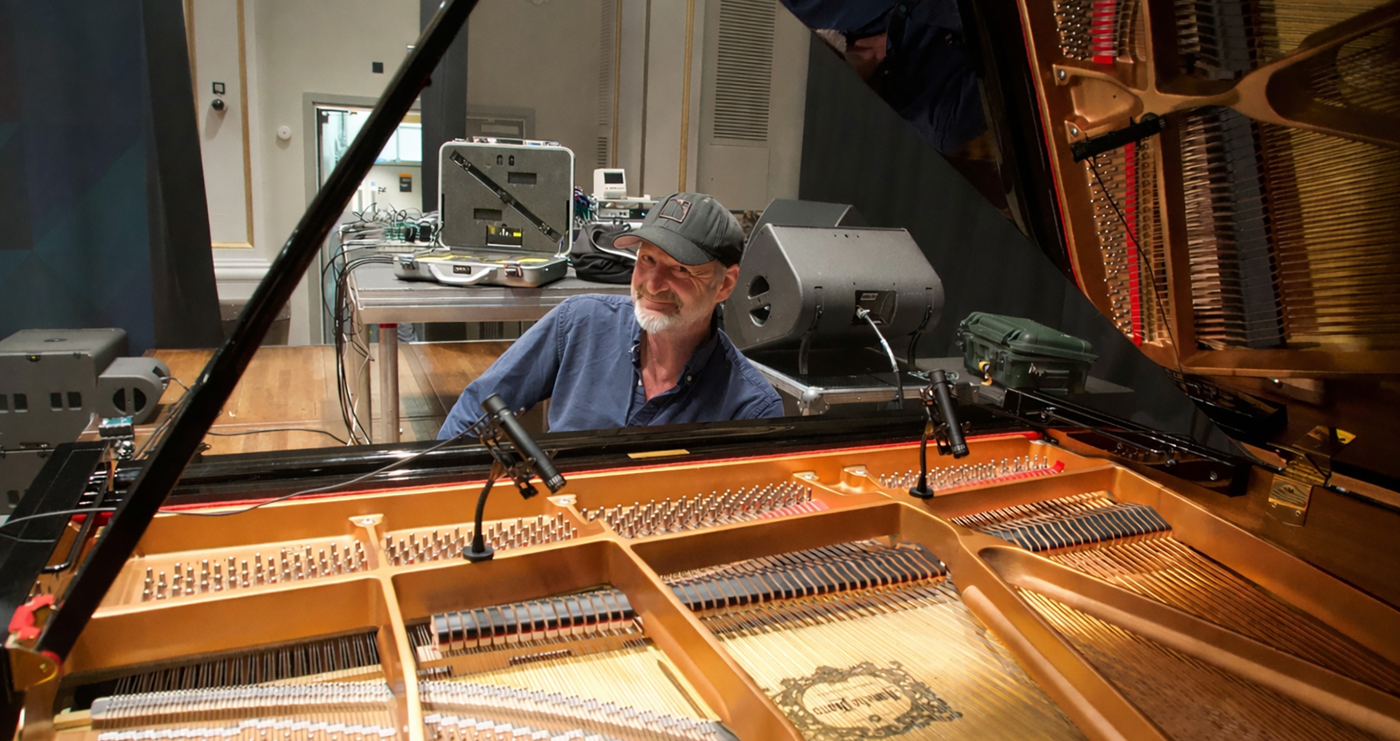
To solve these challenges, Harley turned to the DPA DPK2015 Piano Stereo Kit, which includes a stereo pair of DPA 2015 Wide Cardioid Microphones. The 2015s were positioned inside the piano to capture both clarity and depth across the instrument's full range. "I was really interested to see how the piano kit would handle that, and it worked extremely well," he says.
The wide cardioid pickup pattern allowed Harley to capture the natural resonance of the piano while keeping unwanted bleed under control. "Having that directional control is a godsend," he says. "Especially when you're working with a very quiet, delicate instrument on a large system. You need microphones that keep everything tight and focused exactly where they need to be."
One practical benefit was the reduction in corrective EQ work. "With cheaper microphones, you often hear the mid-range start to get fuzzy or unpleasant, and then you're reaching for EQ to fix problems the mics are introducing," Harley explains. "I didn't have to do that with the 2015s. There were small adjustments, of course, but nothing drastic. That's exactly what you want."
Low-end was another area where the 2015s delivered without additional tools. "We experimented with other solutions for low-end weight, but in the end, I didn't need them," he explains. "If you position the microphones correctly and tune the system properly, you get more than enough warmth and power from the piano itself. Most importantly, it doesn't muddy the mid-range."
The kit also held up practically on the road. "It's absolutely rock-solid," Harley says. "The kit comes in a great case, and everything is well thought out. It held up brilliantly throughout the tour."
What four decades of live sound teaches you
Harley's confidence in DPA goes back decades, to the brand's Brüel & Kjær heritage. "I've known DPA products since the early days in the studio," he recalls. "Even back then, they were superb. They've always been a sensible company making very high-quality products."
Across his career, Harley has also used DPA 4099 Instrument Microphones and d:facto Vocal Microphones on various projects. On this tour, the lesson was clear: when the source is quiet, delicate and changes every night, the microphone choice matters more, not less. "DPA makes that job much easier," he says.