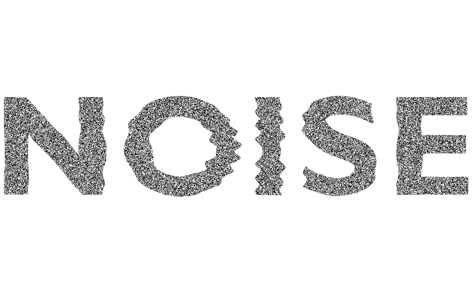
Etymologically the word can be traced back to Old French (noyse) and to eleventh-century Provencal (noysa, nosa, nausa), but its origin is uncertain. It has a variety of meanings and shadings of meaning, the most important of which are the following:
1. Unwanted sound. The Oxford English Dictionary contains references dating back to 1225 that refer to noise as an unwanted sound.
2. Unmusical sound. The nineteenth-century physicist Hermann Helmholtz employed the term "noise" to describe sound composed of nonperiodic vibrations (such as the rustling of leaves), in contrast to musical sounds, which consist of periodic vibrations. Noise is still used in this sense in expressions such as 'white noise' or 'Gaussian noise'.
3. Any loud sound. In general usage today, noise often refers to particularly loud sounds. In this sense, a noise abatement law prohibits certain loud sounds or establishes permissible limits for them in decibels.
4. Disturbance in any signaling system. In electronics and engineering, noise refers to any disturbance that does not represent part of the signal, such as static on a telephone or snow on a television screen.
The most satisfactory definition of noise for general usage is still "unwanted sound." This makes noise a subjective term. One man's music may be another man's noise. But it leaves open the possibility that, in each society, there will be more agreement than disagreement about which sounds constitute unwanted interruptions. It should be noted that each language preserves unique nuances of meaning for words representing noise. Thus, in French, one speaks of the bruit (French for noise) of a jet but also the bruit of the birds or the bruit of the waves.
(Source: Schafer, R. Murray: Our Sonic Environment and the soundscape: the tuning of the world. Destiny Books 1994).
 Lavalier
 Headset & Earset
 Handheld
 Instrument
 Pencil
 Shotgun
 Gooseneck
 Immersive
 Kits
Kits
 Receiver
 Bodypack Transmitter
 Handheld Transmitter
 Antennas
 Antenna Distribution
 Charger & Batteries
 Wisycom